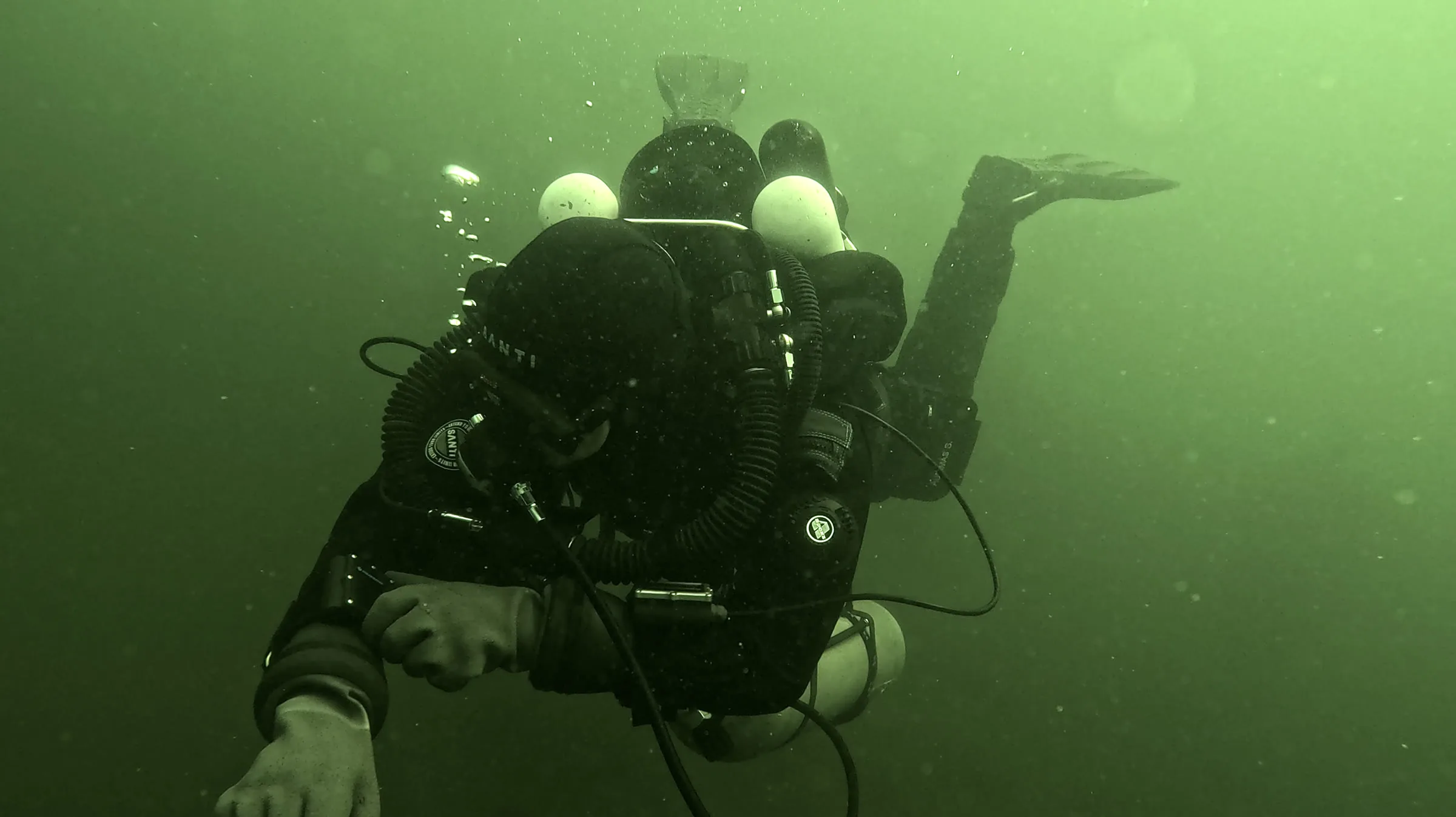
Rebreather diving without bubbles
TDI Air Diluent CCR is TDI's entry-level rebreather course for divers who want to learn to dive a closed circuit rebreather (CCR). The rebreather removes the carbon dioxide from your exhaled gas and replaces the oxygen you use, so there are no bubbles underwater and the oxygen partial pressure stays constant at any depth. The diluent on this course is air or nitrox, and the dives are without decompression, to 30 metres.
The course is taught on one specific rebreather model: the instructor and students use the same unit throughout, and the certificate is valid for the model you trained on.
What you learn
- How the rebreather works: open, semi-closed and closed circuit compared, assembling and taking the unit apart, packing and looking after the absorbent canister, cleaning the breathing loop, minimum and optimum loop volume.
- Physiology: oxygen risks (hyperoxia, toxicity, hypoxia), nitrogen absorption, carbon dioxide build-up (hypercapnia), gas density.
- Electronics: oxygen sensors and their calibration, the oxygen partial pressure setpoint and switching it, dive computers for rebreathers.
- Planning: oxygen and nitrogen limits, CNS loading, scrubber duration, bailout gas requirements, diving in a team with open-circuit divers.
- Emergencies: bailing out to open circuit, a flooded loop, sensor and battery warnings, the B.A.D.-D.A.S. sequence.
How the course runs
The theory takes at least 6 hours, plus a 2-hour rebreather maintenance workshop. Before the open-water dives you configure your equipment and train for at least an hour in the pool (to 9 m). In open water you spend at least 420 minutes in total, increasing the depth gradually; two dives go to at least 24 m. There are no more than three dives a day.
Before every dive you build the rebreather using the manufacturer's checklist, check the canister and the breathing loop, do the positive and negative pressure checks and analyse the oxygen and diluent. On the way down you stop at 3–6 m to check for leaks. In the water you learn to control buoyancy with loop volume, BCD and suit, and to hover in place (±1 m) for at least 90 seconds without moving your hands or feet.
The instructor simulates failures: a gas shutdown, a broken hose, a flooded canister, carbon dioxide breakthrough, low and high oxygen, electronics and battery failure. You bring a non-responsive rebreather diver to the surface from at least 5 m. After the dives you clean and disinfect the unit, replace an oxygen sensor and the batteries, and strip and rebuild the mouthpiece. The course ends with a written exam (pass mark 80 %).
What comes next
After the course you can dive the rebreather model you trained on without an instructor's supervision, to 30 m without decompression, in conditions like those of your training. If you do not dive the rebreather for more than 6 months after the course, TDI requires a refresher.
With at least 30 hours and 30 dives on the rebreather and 6 months of experience, you can go on to Air Diluent CCR Decompression Procedures: decompression dives on a rebreather to 40 m. The other route is Helitrox CCR: decompression dives to 45 m with a helium-based diluent.
Frequently asked questions
What does "Air Diluent" mean?
The diluent is the gas the rebreather uses to dilute the oxygen in the breathing loop. On this course it is air or nitrox, so the dives are limited to 30 m and are without decompression.
Is the certificate valid for any rebreather?
No. TDI rebreather courses are taught on a specific model, and the certificate is valid for the rebreather you trained on. To dive another model you need a shorter crossover course: at least an hour in the pool and four open-water dives (240 minutes). It requires 10 logged rebreather dives in the last 12 months.
I have no nitrox certificate. Can I start?
Yes. TDI allows the Nitrox Diver or Advanced Nitrox course to be completed together with this course. Write to us and we will plan both courses together.
Are there decompression dives on this course?
No. Air Diluent CCR is for dives without decompression. Decompression diving on a rebreather is taught on the Air Diluent CCR Decompression Procedures and Helitrox CCR courses.