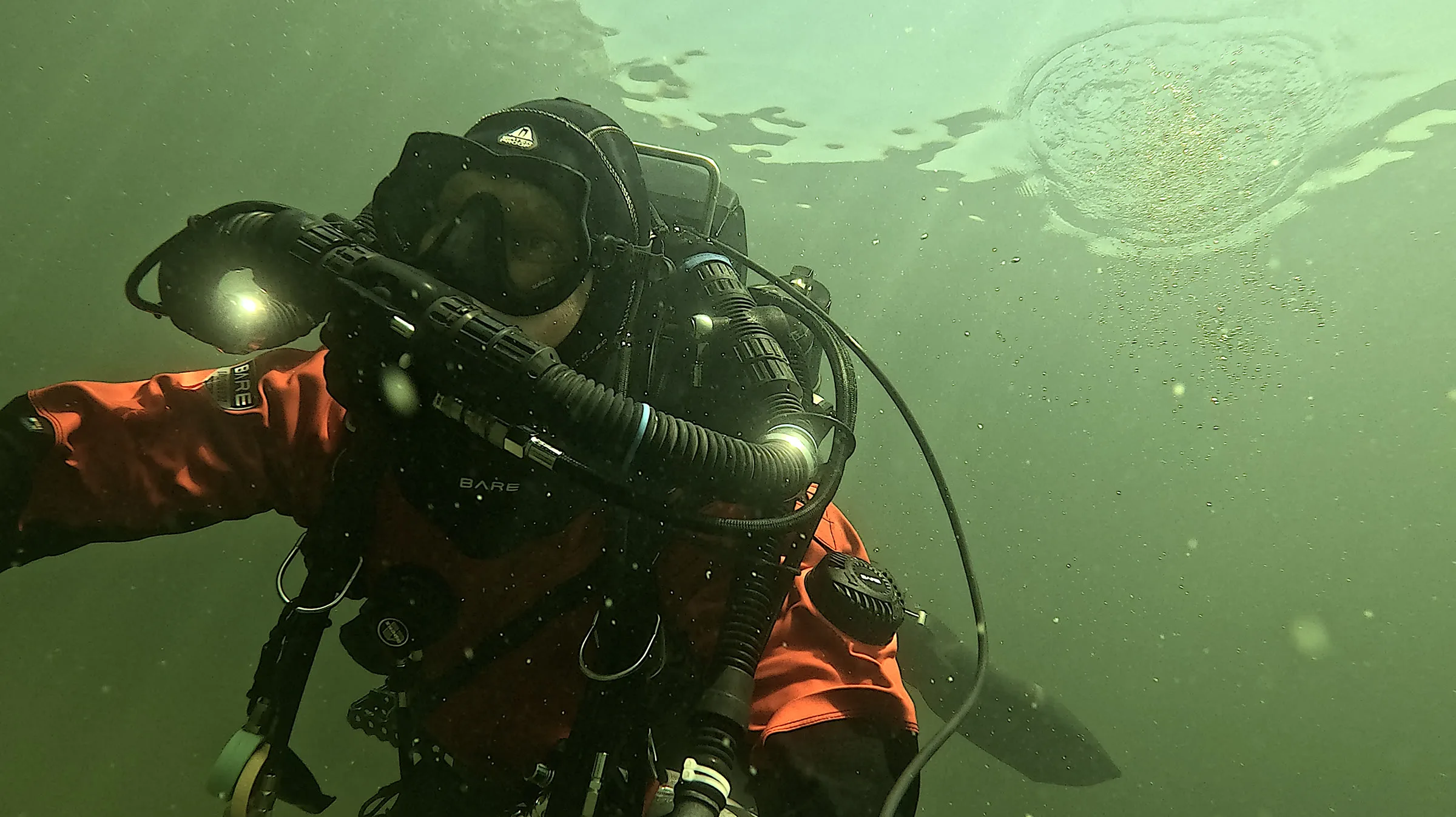
Diving with a rebreather
A closed circuit rebreather (CCR) does not release your exhaled gas into the water: the carbon dioxide is removed and the oxygen you use is replaced. So there are no bubbles and no noise underwater, and fish and other animals are not scared away. Underwater photographers, videographers and nature researchers value this especially. You breathe a warm, moist mix.
The rebreather keeps a constant oxygen partial pressure, so the mix always suits your depth, and longer, deeper dives with advanced decompression strategies become safe and efficient. The technology has been refined over decades, but rebreather diving demands more attention, care and good theoretical and practical preparation.
Three course levels
PADI Rebreather Diver
The first level, on a Type R (recreational) rebreather whose modern electronics make it easier to use. You learn to prepare the rebreather for a dive, do a bubble check and bail out to open circuit, recognise and solve basic problems, control buoyancy on closed circuit and look after the rebreather after the dive. Afterwards you can dive a Type R rebreather on your own to 18 m. The course takes 4 days.
PADI Advanced Rebreather Diver
You keep diving a Type R rebreather, but to 40 m within no-stop limits. You learn to use an extra (bailout) cylinder with an open-circuit regulator for emergencies and to keep the breathing loop at minimum volume, refine your buoyancy and solve rebreather problems during the dive. The course takes 3 days.
PADI Tec 40 CCR
The technical level, on a Type T (technical) rebreather: the AP Diving Vision. You learn the technical diving mindset and procedures, manual control of the rebreather, decompression dives to 40 m and decompression planning tools. A lot of attention goes to spotting, preventing and solving possible problems. The course takes 6 days.
Frequently asked questions
How is a rebreather different from ordinary scuba?
Ordinary scuba (open circuit) releases every breath into the water. A rebreather scrubs the carbon dioxide from your exhaled gas and adds oxygen, so there are no bubbles, gas is used sparingly and the mix always suits your depth.
Which level should I choose?
For quiet recreational dives to 18 m, start with Rebreather Diver. Advanced Rebreather Diver lets you dive to 40 m without decompression. If you are after technical diving with decompression, choose Tec 40 CCR.
What equipment is used?
A basic diving kit, a delayed surface marker buoy (DSMB) with reel, and the rebreather. Advanced Rebreather Diver and Tec 40 CCR add a bailout cylinder with regulator; Tec 40 CCR also a backup computer that supports CCR profiles, a compass and an oxygen analyser.
Is rebreather diving safe?
Rebreather technology has been refined over decades and offers a high level of safety, but it demands more attention and better preparation than ordinary diving. That is why the courses spend a lot of time on recognising problems and bailing out to open circuit.