Completing your entry-level tec training
Tec 50 completes the PADI Tec Deep programme and takes you past the limits of recreational diving. You learn to make decompression dives to 50 metres using two different gases for decompression: nitrox and/or oxygen. You plan dives with decompression software and create your own dive tables. After the course you are qualified to make technical decompression dives independently.
What you learn
- Multi-gas diving: the strategy and risks of several decompression mixes, organising equipment with two stage cylinders.
- Decompression planning: long and deep profiles, distributing stops, backup plans, building a profile from scratch.
- Gas switching: a step-by-step switching sequence, human errors and how to avoid them, switching under heavy task loading.
- Emergencies: losing one or more gases, decision priorities, team decisions.
- Dive planning: goals, logistics, risk assessment and the go / no-go decision.
- Thinking underwater: decision-making, reading the situation, self-control and teamwork.
How the course runs
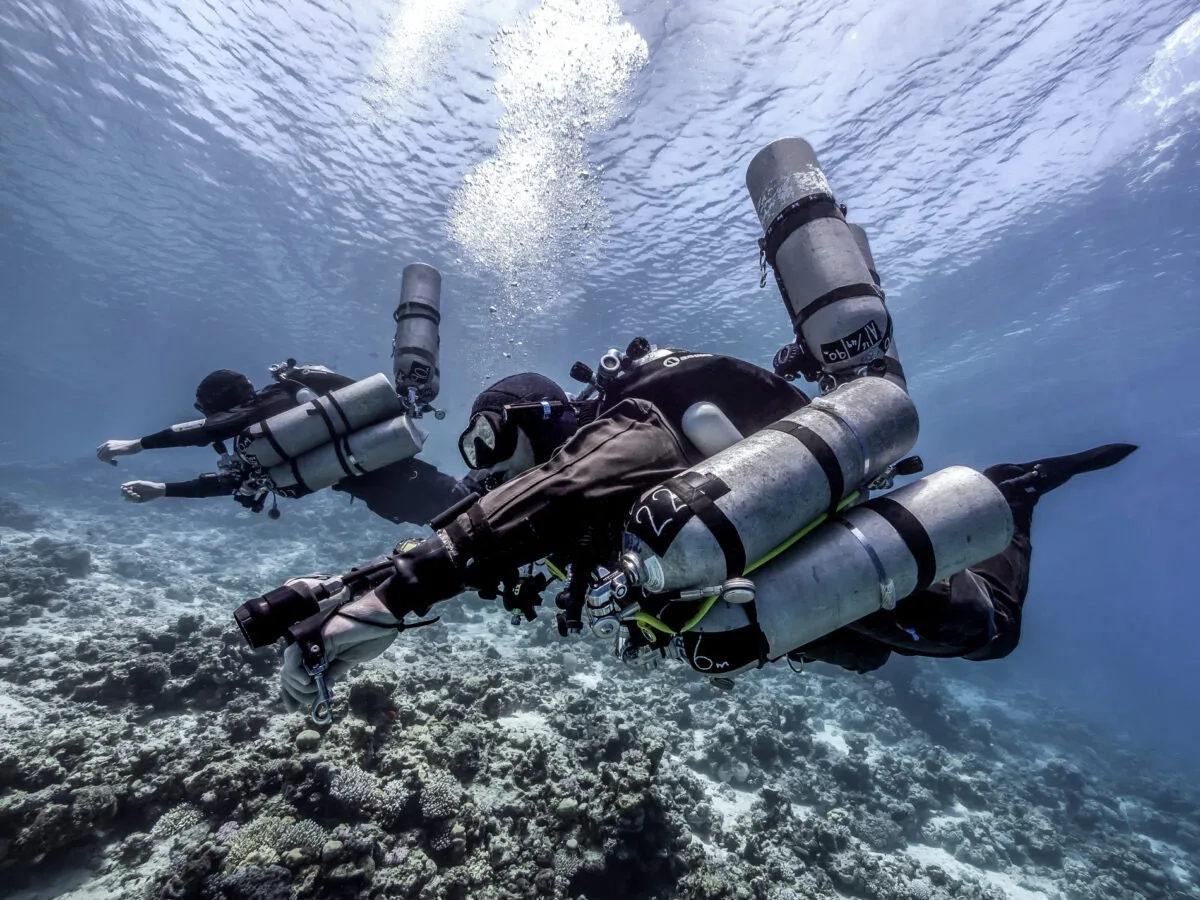
You dive in a full technical configuration: two stage cylinders, clearly separated and marked regulators, multi-gas computers and backup timers and depth gauges. A lot of attention goes to ergonomics and managing task loading, while wrong-switch scenarios and complex simulations train your decision-making.
The course ends with a complete dive that you plan and carry out yourself, assessed by the instructor.
Diving deeper than 50 m requires trimix training.
Frequently asked questions
How is Tec 50 different from Tec 45?
Tec 45 uses one decompression gas, Tec 50 uses two, for example EANx and oxygen. Depth increases to 50 m.
What can I do after the course?
Plan and make technical decompression dives to 50 m with two decompression gases on your own.
How long does the course take?
3–5 days, including theory and four open-water dives. We agree the schedule with you.
What equipment do you provide?
We provide the course equipment, including two stage cylinders for the decompression gases.